Positions Berlin Art Fair 2026: Jérôme Fortin + Ernstina Eitner

[Die deutsche Übersetzung folgt] Pierre-François Ouellette art contemporain is pleased to participate in POSITIONS Berlin for the third consecutive year as part of Berlin Art Week. The gallery presents Jérôme Fortin’s explorations in printmaking, marking his return to Berlin after participating in Art Forum Berlin in 2003 and 2005, alongside works from three recent series by Berlin-based artist Ernstina Eitner. The gallery gratefully acknowledges the financial support of the Société de développement des entreprises culturelles du Québec (SODEC).
At first glance, the practices of Jérôme Fortin and Ernstina Eitner take very different paths. Yet the works brought together by PFOAC at POSITIONS Berlin share an interest in gesture, repetition, and transformation.
For Fortin, a strip of paper is folded, refolded, and printed. Repeating the same process generates countless variations, each revealing its own geometry.
For Eitner, craft becomes a vehicle for memory and transmission. Embroidering, knotting, binding: inherited or reconstructed techniques reactivate family and cultural knowledge at risk of disappearing.
In both practices, repetition never produces exactly the same thing. It transforms. Gesture becomes method, memory, and a space for invention.
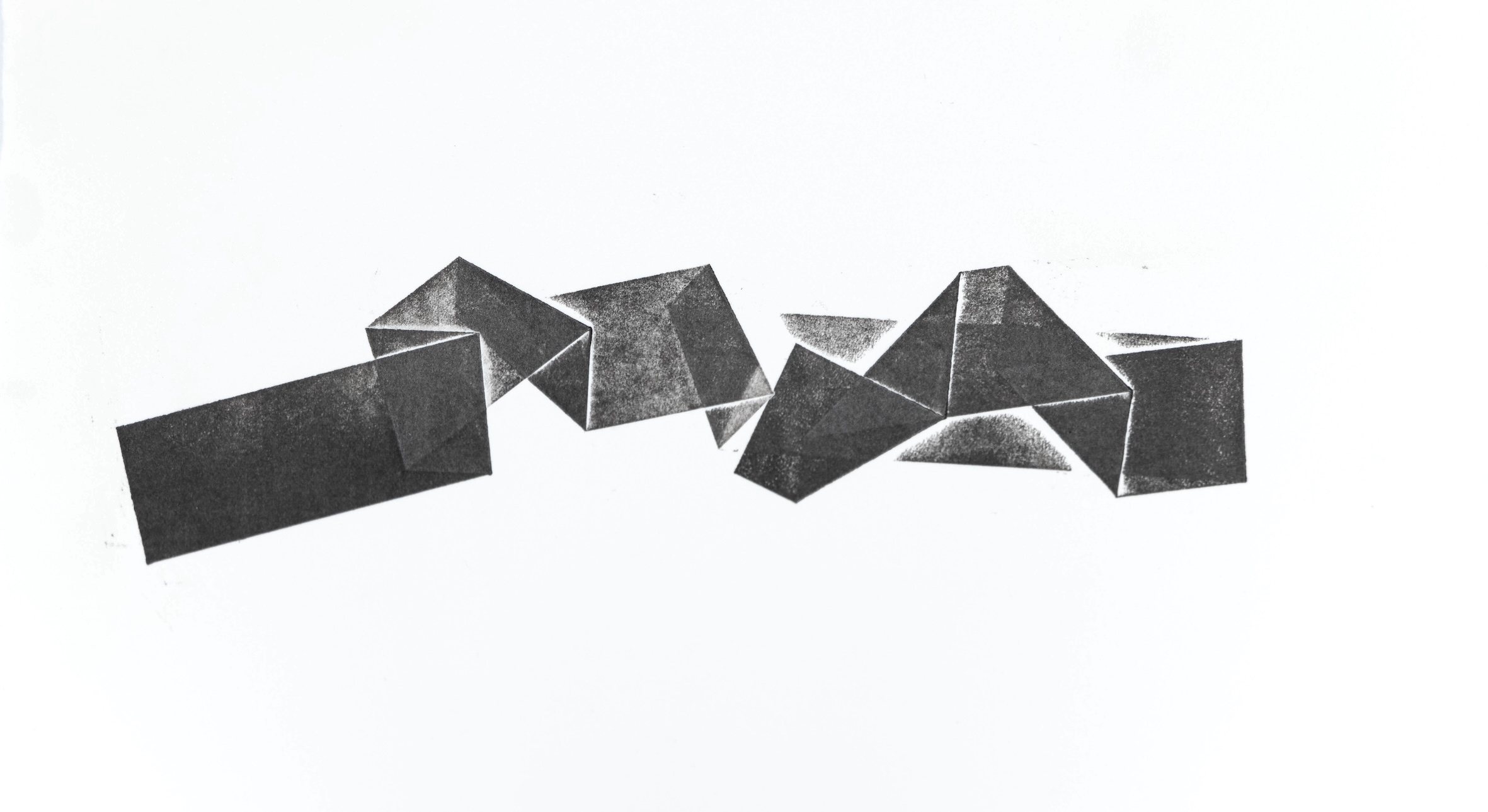
LINES: AN INVITATION TO FOLLOW THE PATH OF THE HAND
The line
It moves forward
It moves back
Dynamic
Disjointed
Dancing
Floating
A horizon in an imaginary white landscape
An accordion of nuances
Kite origami
Spatial punctuation
Games of folding
Games of metamorphosis
Imprinted line
Line, memory of gestures
Lifeline
"The Lines series always begins from the same point of departure: a rectangular strip of paper of identical dimensions. Jérôme Fortin folds and refolds it several times. He then prints the folded form, preserving only its imprint. This imprint becomes both the core and the defining motif of this intimate series. The artist explores the many possibilities inherent in a single basic unit, creating a succession of related compositions. Lines presents a multitude of variations generated through the same formal process.
From a distance, the eye leaps from one work to another, from one line to the next, tracing a dotted path. Up close, the uniqueness of each print gradually reveals itself. Each time, Fortin creates a small visual labyrinth. He delights in constructing delicate geometric pathways where triangles, rectangles, trapezoids, and invented shapes lie hidden. The white traces running through the compositions suggest the places where the paper was folded. They invite viewers to decipher these rhythmic forms. The curious eye lingers over these playful, asymmetrical ribbons, following their patterns from left to right, then from right to left. Which side is the front? Which is the back?
The white background heightens the subtle contrasts of each print. Across the surface, delicate shades of gray and black unfold through layers that are alternately translucent and opaque. A careful gaze detects the grain of the paper emerging within the overlapping forms and textures, bringing the printed surface to life.
With Lines, Fortin remains true to his distinctive visual language while simultaneously renewing it. Although he has often worked with papers bearing figurative imagery—manga pages, road maps, lottery tickets, colouring books—here he ventures into abstraction. The horizontal orientation so characteristic of his work remains present, yet becomes subtly disrupted. As in the earlier series Partita and Tabula Rasa, he moves away from the strict regularity of his previous compositions, dominated by parallel horizontal lines (Screen, Grey Series). In Lines, the artist pushes this exploration even further, emphasizing singularity, the irregularity of forms, and oblique lines. While his visual language evolves, Fortin also returns to elements central to his practice: the exploration of black and white, the repetition of gestures, the use of paper, and processes of transformation (Mamoru, Tondo, Excerpts).
Minimalist and refined, the Lines series reveals the full extent of Jérôme Fortin’s creativity and ingenuity." Ariane Léonard. Art Historian

Jérôme Fortin was born in Joliette, Québec, in 1971, and lives and works in Montreal. Since 1996, he has presented more than a dozen solo exhibitions in Prague, Pretoria, Tokyo, Paris, Toronto, and Montreal. He has also participated in numerous group exhibitions in Istanbul, Berlin, Bologna, Brussels, Paris, Cuba, Barcelona, Beijing, and New York.
Fortin has completed several artist residencies, including at the World Financial Center Arts & Events (New York), the Christoph Merian Foundation (Basel), FONCA (Mexico City), the Cité internationale des arts (Paris), the Ludwig Foundation of Cuba (Havana), and Tokyo Wonder Site (Tokyo). In 2007, the Musée d’art contemporain de Montréal (MACM) presented a solo exhibition of his work. In 2004, he received the Pierre-Ayot Award from the City of Montreal.
His works are included in numerous public and private collections, including those of the Musée d’art contemporain de Montréal, the Musée national des beaux-arts du Québec, the Musée de Joliette, the Pretoria Art Museum, the National Museum of China, Bibliothèque et Archives nationales du Québec, the Canada Council Art Bank, the City of Montreal, as well as corporate and private collections. Fortin is the Coordinator of the Visual Arts Program at Cégep du Vieux Montréal.
ERNSTINA EITNER

Ernstina Eitner (b. 1992, lives and works in Berlin) engages with cultural phenomena, social questions and everyday practices. Her work comprises mainly objects, textile works and drawings, which she often brings together into installations. She works with a wide range of materials and techniques, which she draws from various contexts and develops further for her practice.
Ernstina Eitner first studied in Kiel and Szczecin – with Antje Majewski, Sophie Reinhold, Michael Beutler and Olga Lewicka, among others – and completed her degree in Fine Arts in 2023, receiving the postgraduate title of Meisterschülerin under Ina Weber at the Berlin University of the Arts. She currently also teaches there.
Her work has been shown in numerous exhibitions in Germany and abroad, including Laura Mars Gallery in Berlin (DE), Kunstraum Hase29 in Osnabrück (DE), Maison de la culture Janine-Sutto in Montreal (CA), Künstlerhaus Bregenz (AT) and Barkenhoff/Große Kunstschau in Worpswede (DE).
In 2026 she received an artist residency grant from GEDOK Schleswig-Holstein in Lübeck and took part in a duo residency at Projektraum Dose in Hamburg. In 2025 she was a fellow at Villa Fohrde. In the same year she received funding from the Projektfonds Kulturförderung Friedrichshain-Kreuzberg (district cultural fund, Berlin) for the exhibition PASSEN. In 2023 she was nominated for the L102.art Prize.
In her artistic practice, Ernstina Eitner repeatedly explores questions of origin and cultural influence. Her starting points are craft techniques, customs, food culture, and stories that her Black Sea German family brought with them from Kazakhstan. She researches them, reconstructs what was believed lost, and reappropriates inherited knowledge. The works that emerge carry traces of a family history while asserting something of their own.
On view is a selection of works from three different series:

Bindelarven/Schutzobjekte (Bound Larvae/Protective Objects) are bound after the model ofdolls that the women in the artist's family once made in Kazakhstan to say goodbye to winter and welcome spring. Eitner has adopted the ritual and repurposed it to get rid of unwanted creatures.The work is a humorous yet critical engagement with magical thinking, particularly in post-Soviet culture.
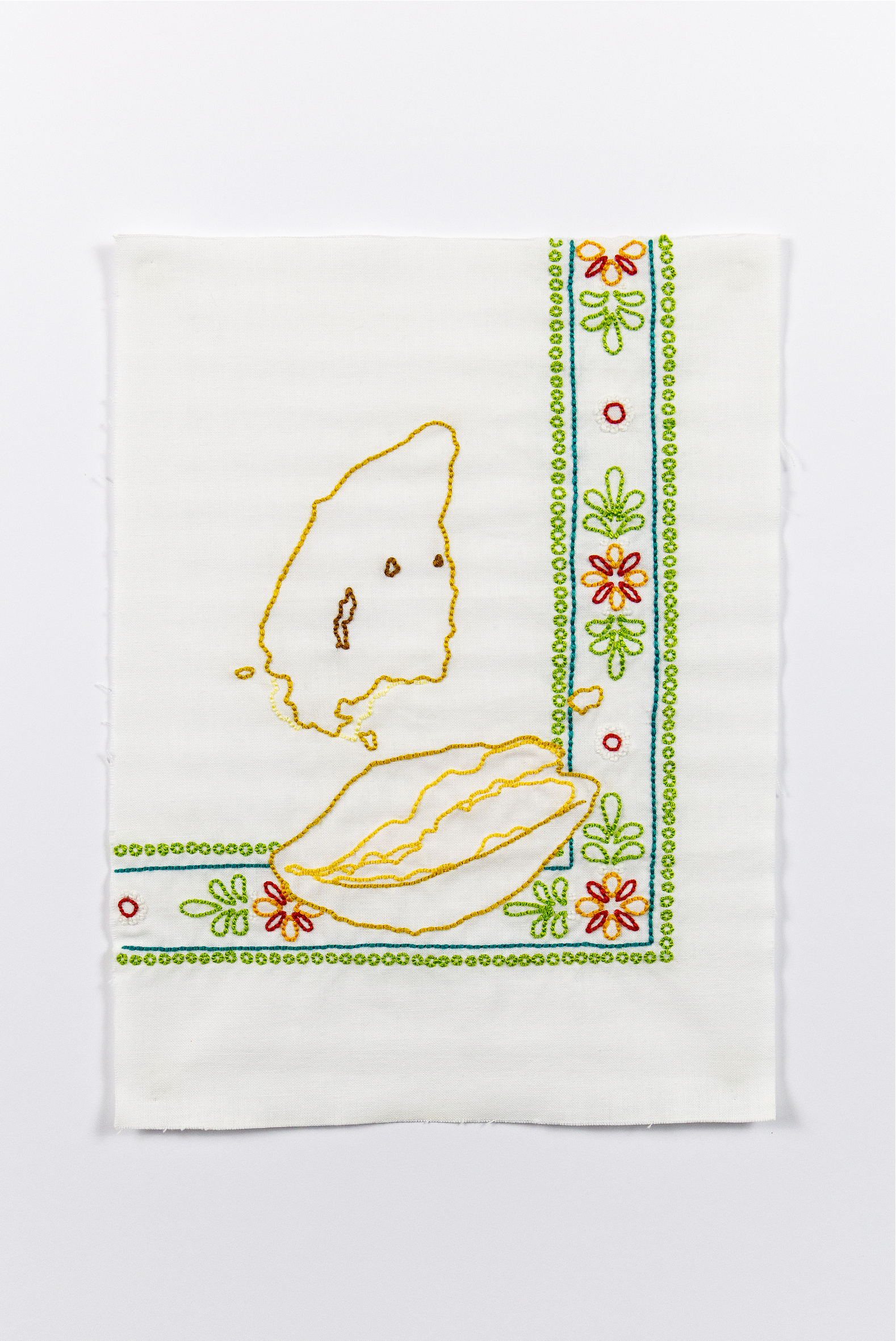
The series Mutterzungen (Mother Tongues) presents embroidered forms that refer to dishes and can be read as signs. Recipes are passed on and preserved within families; they often reveal more about origin than spoken language does. Personal histories and identities are overwritten when a mother tongue is subject to political arbitrariness or the product of colonial violence. Food culture, by contrast, makes continuities and hybridities visible. The title shifts the mother tongue back into the body: from what is spoken to what is tasted.

Drei Rubel (Three Rubles) and Überwintern (Overwintering) are bound in the same way as the brooms that Eitner’s grandparents made in Kazakhstan. The smaller hand brooms, called veniki, were an important source of income there: each year they bound up to a thousand of them to sell at the nearby market for three rubles each. The artist's father was taught broom-binding as a boy. As it was of no further use to him in Germany, this craft knowledge fell into oblivion, and only through extensive conversations was Eitner able to reconstruct it and make it productive for her artistic work. The brooms belong to a group of everyday objects whose making she has reappropriated in this way.
______
Die Galerie Pierre-François Ouellette freut sich, im Rahmen der Berlin Art Week zum dritten Mal in Folge an der POSITIONS Berlin teilzunehmen. Parallel präsentiert die Galerie die druckgrafischen Erkundungen von Jérôme Fortin, der nach seiner Teilnahme am ArtForum Berlin in den Jahren 2003 und 2005 nach Berlin zurückkehrt, sowie Werke aus drei aktuellen Serien der Berliner Künstlerin Ernstina Eitner.
Die Galerie dankt der Société de développement des entreprises culturelles du Québec (SODEC) für ihre finanzielle Unterstützung.
Jérôme Fortin nutzt fuer die Herstellung seiner Druckgrafiken verschiedene Drucktechniken wie Siebdruck, Lithografie, Linolschnitt und Collagraphie. Einige seiner Druckplatten sind Bestandteil großformatiger, permanenter Kunstinstallationen im öffentlichen Raum, die er im Rahmen von Québecs Programm zur Integration von Kunst in die Architektur realisiert hat
Darüber hinaus arbeitet er im Bereich der Skulptur. Für seine Assemblagen entfremdet er Alltagsgegenstände wie Korken, Plastikflaschen, Bücher oder Streichhölzer und verwandelt sie in Anspielungen auf Blumen, Muscheln, Schmuckstücke und Amulette, wie sie einst in den Wunderkammern des 15. Jahrhunderts gesammelt wurden.
Jérôme Fortin nimmt regelmäßig an bedeutenden nationalen und internationalen Kunstausstellungen teil. Seine Werke waren unter anderem in Einzelausstellungen in Prag, Pretoria, Tokio, Paris, Washington und Toronto zu sehen. 2007 widmete ihm das Musée d’art contemporain de Montréal eine Einzelausstellung. Darüber hinaus war er an zahlreichen Gruppenausstellungen beteiligt, etwa in Istanbul, Berlin, Bologna, Brüssel, Paris, Havanna, Barcelona, Beijing, Mexiko-Stadt und New York.
2004 wurde Jérôme Fortin mit dem Pierre-Ayot-Preis ausgezeichnet. Seine Werke befinden sich in bedeutenden öffentlichen Sammlungen, darunter das Musée d’art contemporain de Montréal, das Musée national des beaux-arts du Québec, das Musée d’art de Joliette, das Pretoria Art Museum, das National Museum of China, die Bibliothèque et Archives nationales du Québec, die Art Bank des Canada Council for the Arts sowie die Kunstsammlung der Stadt Montréal.
LINIEN: EINE EINLADUNG, DEM WEG DER HAND ZU FOLGEN
Die Linie
Sie schreitet voran
Sie weicht zurück
Dynamisch
Fragmentiert
Tanzend.
Schwebend.
Ein Horizont in einer weißen, imaginären Landschaft
Ein Akkordeon aus Nuancen
Origami-Drachen
Räumliche Interpunktion
Faltspiele
Verwandlungsspiele
Linie als Spur
Linie als Gedächtnis der Gesten
Lebenslinie
Am Ursprung der Serie Linien steht stets derselbe Ausgangspunkt: ein rechteckiger Papierstreifen mit identischen Maßen. Jérôme Fortin faltet und entfaltet ihn mehrfach. Anschließend druckt er die Faltung und bewahrt lediglich deren Abdruck. Dieser bildet das Herzstück und das zentrale Motiv dieser intimen Werkserie. Der Künstler erkundet die vielfältigen Möglichkeiten, die einer einzigen Grundeinheit innewohnen, und erschafft so eine Reihe miteinander verbundener Kompositionen. Linien präsentiert eine Vielzahl von Variationen desselben bildnerischen Verfahrens.
Aus der Ferne springt der Blick von Werk zu Werk, von Linie zu Linie, und folgt einem gepunkteten Pfad. Aus der Nähe offenbart sich die Einzigartigkeit jedes einzelnen Drucks. Fortin erschafft jedes Mal ein kleines visuelles Labyrinth. Mit spielerischer Leichtigkeit entwickelt er feine geometrische Linienführungen, in denen sich Dreiecke, Rechtecke, Trapeze und erfundene Formen verbergen. Die weißen Spuren innerhalb der Kompositionen lassen erahnen, wo das Papier gefaltet wurde. Sie laden die Betrachtenden dazu ein, diese kleinen rhythmischen Formen zu entschlüsseln. Der neugierige Blick bleibt an diesen verspielten, asymmetrischen Bändern haften und wandert ihren Mustern folgend von links nach rechts und wieder zurück. Wo befindet sich die Vorderseite? Wo die Rückseite?
Der weiße Hintergrund hebt die feinen Kontraste jeder Druckgrafik hervor. Auf der Oberfläche entfalten sich die Nuancen von Grau und Schwarz subtil in Überlagerungen, mal hell und transparent, mal dicht und opak. Der aufmerksame Blick erkennt in den Drucken die Struktur des Papiers, die in den Schichtungen und Texturen lebendig wird.
Mit Linien bewahrt Fortin seine charakteristische Bildsprache und erneuert sie zugleich. Während er in zahlreichen früheren Arbeiten Papiere mit figurativen Motiven verwendete – Mangas, Straßenkarten, Lottoscheine oder Malbücher –, wendet er sich hier der Abstraktion zu. Die für sein Werk so charakteristische Horizontalität bleibt erhalten, wird jedoch leicht aufgebrochen. Bereits in den Serien Partita und Tabula rasa entfernte er sich von der strengen Ordnungfrüherer Kompositionen, die von horizontalen, parallelen Linien geprägt waren (Écran, Série grise). Mit Linien treibt der Künstler diesen Gedanken noch weiter. Er rückt die Eigenständigkeit und Unregelmäßigkeit der Formen sowie die schräg verlaufenden Linien in den Vordergrund. Während sich seine Bildsprache weiterentwickelt, greift Fortin zugleich Elemente auf, die sein Werk seit Langem prägen: die Erforschung von Schwarz und Weiß, die Wiederholung von Gesten, die Arbeit mit Papier sowie das Spiel mit der Transformation (Mamoru, Tondo, Extraits).
In ihrer minimalistischen und reduzierten Form offenbart die Serie Linien die ganze Kreativität und den Erfindungsreichtum von Jérôme Fortin. - Ariane Léonard, Kunsthistorikerin
Ernstina Eitner (*1992, lebt und arbeitet in Berlin) setzt sich in ihren künstlerischen Arbeiten mit kulturellen Phänomenen, Gesellschaftsfragen und Alltagspraktiken auseinander. Ihr Werk umfasst vor allem Objekte, Textilarbeiten und Zeichnungen, die sie häufig zu Installationen zusammenführt. Dabei arbeitet sie mit einem breiten Spektrum an Materialien und Techniken, die sie aus verschiedenen Kontexten aufgreift und für ihre künstlerische Praxis weiterentwickelt.
Ernstina Eitner studierte zunächst in Kiel und Stettin – unter anderem bei Antje Majewski, Sophie Reinhold, Michael Beutler und Olga Lewicka – und schloss ihr Studium der Bildenden Kunst 2023 als Meisterschülerin bei Ina Weber an der Universität der Künste Berlin ab. Dort ist sie aktuell auch als Lehrbeauftragte tätig.
Ihre Arbeiten waren in zahlreichen Ausstellungen im In- und Ausland zu sehen – u.a. Laura Mars Gallery in Berlin (DE), Kunstraum Hase29 in Osnabrück (DE), Maison de la culture Janine-Sutto in Montreal (CA), Künstlerhaus Bregenz (AT) und Barkenhoff/Große Kunstschau in Worpswede (DE).
2026 erhielt sie ein Wohn- und Arbeitsstipendium der GEDOK Schleswig-Holstein in Lübeck und nahm an einer Duo-Residenz des Projektraums Dose in Hamburg teil. 2025 war sie Stipendiatin der Villa Fohrde. Im selben Jahr erhielt sie für die Ausstellung PASSEN eine Förderung des Projektfonds Kulturförderung Friedrichshain-Kreuzberg. 2023 war sie für den L102.art Prize nominiert.
Ernstina Eitner beschäftigt sich in ihrer künstlerischen Arbeit immer wieder mit Fragen nach Herkunft und kultureller Prägung. Ausgangspunkt sind dabei Handwerkstechniken, Bräuche, Esskultur und Erzählungen, die ihre schwarzmeerdeutsche Familie aus Kasachstan mitbrachte. Diese erforscht sie, rekonstruiert vergessen Geglaubtes und eignet sich weitergegebenes Wissen neu an. So entstehen Arbeiten, die Spuren einer Herkunftsgeschichte in sich tragen und zugleich etwas Eigenes behaupten.
Zu sehen ist eine Auswahl von Arbeiten aus drei verschiedenen Werkgruppen.
Die Bindelarven/Schutzobjekte sind nach dem Vorbild von Puppen gebunden, wie sie die Frauen in der Familie der Künstlerin einst in Kasachstan herstellten, um den Winter zu verabschieden und den Sommer zu begrüßen. Eitner hat sich das Ritual angeeignet und umgewidmet, um unliebsames Kleingetier fernzuhalten. Die Arbeit ist eine ebenso humorvolle wie kritische Auseinandersetzung mit magischem Denken – insbesondere in der postsowjetischen Kultur.
Die Serie Mutterzungen zeigt gestickte Formen, die auf Speisen verweisen und zugleich als Zeichen lesbar sind. Rezepte werden in Familien weitergereicht und bewahrt; sie verraten oft mehr über Herkunft als die gesprochene Sprache. Persönliche Geschichten und Identitäten werden überschrieben, wenn die Muttersprache politischer Willkür unterliegt oder Ergebnis kolonialer Gewalt ist. Die Esskultur hingegen macht Kontinuitäten und Hybriditäten sichtbar. Die Künstlerin setzt der Muttersprache die Mutterzunge entgegen.
Drei Rubel und Überwintern sind gebunden wie die Besen, die Eitners Großeltern in Kasachstan anfertigten. Vor allem die kleineren Handbesen, Veniki genannt, waren dort eine wichtige Einkommensquelle: Bis zu tausend Stück banden sie im Jahr, um sie auf dem nahegelegenen Markt für je drei Rubel zu verkaufen. Dem Vater der Künstlerin wurde das Besenbinden bereits als Junge beigebracht. Da es ihm in Deutschland nicht mehr von Nutzen war, geriet dieses Handwerkswissen in Vergessenheit und es war Eitner nur durch intensive Gespräche möglich, es wiederherzustellen und für ihre künstlerische Arbeit fruchtbar zu machen. Die Besen gehören zu einer Gruppe von Alltagsgegenständen, deren Herstellung sie sich auf diesem Weg neu angeeignet hat.
-
 Jérôme FortinLignes 15, 2022Monotype (Embossage / Embossing)6.5 x 11.25 "
16,51 x 28,58 cm$ 400.00 -
Ernstina EitnerBindelarve/Schutzobjekt (Installation with Bound Larva/Protective Object Nos. 6, 8 and 10), 2026laine, fil de fer, perles en plastique, bois, MDF, carreaux de céramique, crochet en métal, tissu éponge / wool, wire, plastic beads, wood, MDF, ceramic tiles, metal hook, terry cloth42 1/8 x 15 3/4 x 2 3/8 "
107 x 40 x 6 cm1750 € -
Jérôme FortinLignes 17, 2022Monotype (Embossage / Embossing)6.5 x 11.25 "
16,51 x 28,58 cm$ 400.00 -
Ernstina EitnerFusion (from the series Mutterzungen), 2022fil à broder sur tissu de coton / embroidery thread on cotton fabric11 3/8 x 8 1/4 "
29 x 21 cm700 € -
Ernstina EitnerNoch immer Zwetschgenknödel zu Mittag; from the series Mutterzungen (Still Plum Dumplings for Lunch), 2022fil à broder sur tissu de coton / embroidery thread on cotton fabric8 5/8 x 8 1/4 "
22 x 21 cm640 € -
Ernstina EitnerDisplaced Piroshki (from the series Mutterzungen), 2022fil à broder sur tissu de coton / embroidery thread on cotton fabric11 x 8 1/4 in
28 x 21 cm700 € -
Ernstina EitnerPelmeni auf Zwiebelmuster; from the series Mutterzungen (Pelmeni on Blue Onion ), 2022fil à broder sur tissu de coton / embroidery thread on cotton fabric8 5/8 x 8 1/4 "
22 x 21 cm640 € -
Ernstina EitnerDrei Rubel (Three Rubles), 2025millet à balais et ficelle naturelle / broomcorn millet and natural twine29 1/2 x 8 5/8 x 2 3/8 "
75 x 22 x 6 cm1200 € -
Ernstina EitnerÜberwintern (Overwintering), 2024bouleau et fil de fer / birch and wire59 x 9 x 4 3/4 "
150 x 23 x 12 cm1400 € -
Ernstina EitnerBound Larva/Protective Object No. 20 (Bindelarve/Schutzobjekt), 2026laine, fil de fer, perles en plastique et crochet en métal / wool, wire, plastic beads and metal hook9 7/8 x 4 3/4 x 2 3/8 "
25 x 12 x 6 cm -
Ernstina EitnerBound Larva/Protective Object No. 24 (Bindelarve/Schutzobjekt), 2026laine, fil de fer, perles en plastique, tige d'aluminium, bois / wool, wire, plastic beads, aluminium rod, wood18 1/2 x 3 1/8 x 6 1/4 "
47 x 8 x 16 cm680 € -
Ernstina EitnerBindelarve/Schutzobjekt ( Installation with Bound Larva/Protective Object Nos. 7 and 9), 2026laine, fil de fer, perles en plastique, bois, MDF, carreaux de céramique, tissu éponge / wool, wire, plastic beads, wood, MDF, ceramic tiles, terry cloth10 5/8 x 12 5/8 x 12 5/8 "
27 x 32 x 32 cm1150 € -
Ernstina EitnerBound Larva/Protective Object No. 15 (Bindelarve/Schutzobjekt), 2026laine, perles en plastique / wool, plastic beads7 1/2 x 3 3/8 x 1 "
19 x 8.5 x 2.5 cm400 € -
Ernstina EitnerBound Larva/Protective Object No. 16 (Bindelarve/Schutzobjekt), 2026laine, perles en plastique / wool, plastic beads8 1/4 x 3 1/8 x 1 1/8 in
21 x 8 x 3 cm400 € -
Ernstina EitnerBound Larva/Protective Object No. 17 (Bindelarve/Schutzobjekt), 2026laine, perles en plastique / wool, plastic beads7 1/8 x 3 1/8 x 1 "
18 x 8 x 2.5 cm400 € -
Ernstina EitnerBound Larva/Protective Object No. 19 (Bindelarve/Schutzobjekt), 2026laine, perles en plastique / wool, plastic beads7 1/8 x 3 1/2 x 1 1/8 "
18 x 9 x 3 cm400 € -
Ernstina EitnerBound Larva/Protective Object No. 25 (Bindelarve/Schutzobjekt), 2026laine, perles en plastique / wool, plastic beads7 1/2 x 3 1/8 x 1 1/8 in
19 x 8 x 3 cm400 € -
Ernstina EitnerBound Larva/Protective Object No. 26 (Bindelarve/Schutzobjekt), 2026llaine, perles en plastique, anneau en fer / wool, plastic beads, iron rings6 1/4 x 3 1/8 x 1 1/8 in
16 x 8 x 3 cm400 € -
Ernstina EitnerBound Larva/Protective Object No. 27 (Bindelarve/Schutzobjekt), 2026llaine, perles en plastique, anneau en fer / wool, plastic beads, iron ring7 1/2 x 3 1/8 x 1 1/8 in
19 x 8 x 3 cm400 € -
Ernstina EitnerBound Larva/Protective Object No. 28 (Bindelarve/Schutzobjekt), 2026laine, perles en plastique / wool, plastic beads8 1/4 x 4 x 2 in
21 x 10 x 5 cm400 € -
Ernstina EitnerBound Larva/Protective Object No. 4 (Bindelarve/Schutzobjekt), 2025laine, perles en plastique / wool, plastic beads7 1/2 x 3 1/2 x 1 1/8 in
19 x 9 x 3 cm400 € -
Jérôme FortinLignes 20, 2022Monotype (Embossage / Embossing)6.5 x 11.25 "
16,51 x 28,58 cm$ 400.00 -
Jérôme FortinLignes 21, 2022Monotype (Embossage / Embossing)6.5 x 11.25 "
16,51 x 28,58 cm$ 400.00 -
Jérôme FortinLignes 24, 2022Monotype (Embossage / Embossing)6.5 x 11.25 "
16,51 x 28,58 cm -
Jérôme FortinLignes 29, 2022Monotype (Embossage / Embossing)6.5 x 11.25 "
16,51 x 28,58 cm$ 400.00 -
Jérôme FortinLignes 30, 2022Monotype (Embossage / Embossing)6.5 x 11.25 "
16,51 x 28,58 cm$ 400.00 -
Jérôme FortinLignes 31, 2022Monotype (Embossage / Embossing)6.5 x 11.25 "
16,51 x 28,58 cm$ 400.00 -
Jérôme FortinLignes 32, 2022Monotype (Embossage / Embossing)11 1/4 x 6 3/8 "
28.6 x 16.2 cm$ 400.00 -
Jérôme FortinLignes 33, 2022Monotype (Embossage / Embossing)6.5 x 11.25 "
16,51 x 28,58 cm$ 400.00 -
Jérôme FortinLignes 34, 2022Monotype (Embossage / Embossing)6.5 x 11.25 "
16,51 x 28,58 cm$ 400 -
Jérôme FortinLignes 37, 2022Monotype (Embossage / Embossing)6.5 x 11.25 "
16,51 x 28,58 cm -
Jérôme FortinLignes 38, 2022Monotype (Embossage / Embossing)6.5 x 11.25 "
16,51 x 28,58 cm$ 400.00 -
Jérôme FortinLignes 39, 2022Monotype (Embossage / Embossing)6.5 x 11.25 "
16,51 x 28,58 cm -
Jérôme FortinLignes 40, 2022Monotype (Embossage / Embossing)6.5 x 11.25 "
16,51 x 28,58 cm$ 400.00 -
Jérôme FortinLignes 41, 2022Monotype (Embossage / Embossing)6.5 x 11.25 "
16,51 x 28,58 cm$ 400.00 -
Jérôme FortinLignes 43, 2022Monotype (Embossage / Embossing)6.5 x 11.25 "
16,51 x 28,58 cm$ 400.00 -
Jérôme FortinLignes 44, 2022Monotype (Embossage / Embossing)6.5 x 11.25 "
16,51 x 28,58 cm$ 400.00 -
Jérôme FortinLignes 46, 2022Monotype (Embossage / Embossing)6.5 x 11.25 "
16,51 x 28,58 cm$ 400.00 -
Jérôme FortinLignes 49, 2022Monotype (Embossage / Embossing)11 1/4 x 6 3/8 "
28.6 x 16.2 cm$ 400.00 -
Jérôme FortinLignes 51, 2022Monotype (Embossage / Embossing)6.5 x 11.25 "
16,51 x 28,58 cm$ 400.00 -
Jérôme FortinLignes 57, 2022Monotype (Embossage / Embossing)6.5 x 11.25 "
16,51 x 28,58 cm$ 400.00 -
Jérôme FortinLignes 59, 2022Monotype (Embossage / Embossing)6.5 x 11.25 "
16,51 x 28,58 cm$ 400.00 -
Jérôme FortinLignes 6, 2022Monotype (Embossage / Embossing)6.5 x 11.25 "
16,51 x 28,58 cm$ 400.00 -
Jérôme FortinLignes 60, 2022Monotype (Embossage / Embossing)6.5 x 11.25 "
16,51 x 28,58 cm$ 400.00


